Fire Doors
Model ERD10
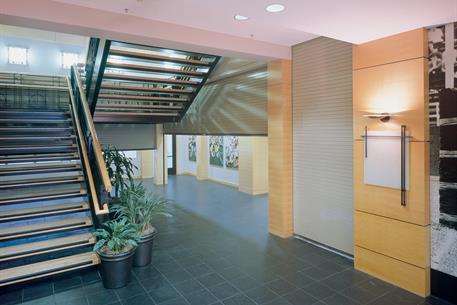
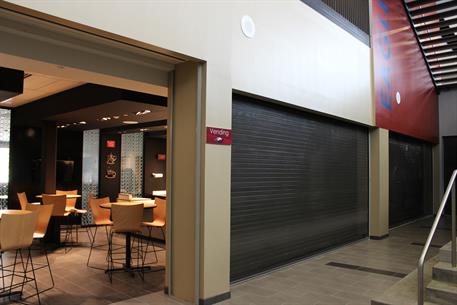
Fire Doors are rated physical fire barriers that protect wall openings from the spread of fire. They provide automatic closing in the event of fire detection with governed speed control. Fire doors are also designed for daily use to provide security and access control, but are for use in openings that are not part of a required means of egress. Cornell offers a complete line of labeled rolling doors for protection in wall openings where rated doors are required by building codes and for insurance purposes.
Fire Door Listings: UL Classified 4 HR, 3 HR, 11/2 HR, 1 HR and 3/4 HR labels and Factory Mutual Approval, see FM Approval Guide. Cornell Fire Doors are listed with the California Office of the State Fire Marshal.
Sizes: 30' wide, 30' high standard construction. Large Openings to 50' wide, 40' high up to 1200 square feet, consult factory.
SmokeShield® Fire Doors: Add UL classified smoke and draft control to fire doors. Containing smoke saves lives and building property and also aids in fire containment by slowing oxygen flow to the fire source. It's simple to double up on the protection of your building and may be required by your local building code. Be sure to add SmokeShield protection to all your Fire Door products.
Specified Wind Load: Fire doors can be designed to meet specific PSF wind load requirements.
Seismic Performance Validation: Cornell can provide project specific seismic calculations for all fire doors that are mounted Face of Wall or Between Jambs to steel or masonry. Seismic performance validation is per ASCE 7-05.
Material and Finishes: curtains are available in 22, 20 and 18 gauge galvanized steel with exclusive GalvaNex™ finish in light gray or tan, SpectraShield® powder coating as an available option, or 20 gauge 300 series stainless steel with #4 finish. Stamped steel or cast iron endlocks are provided per UL procedure. Additional Material and Finishes information…
Fire Door Mounting: Face of wall or between jambs configurations in both interior and exterior walls. Approved wall types for the mounting of fire doors include masonry or structural steel jambs.
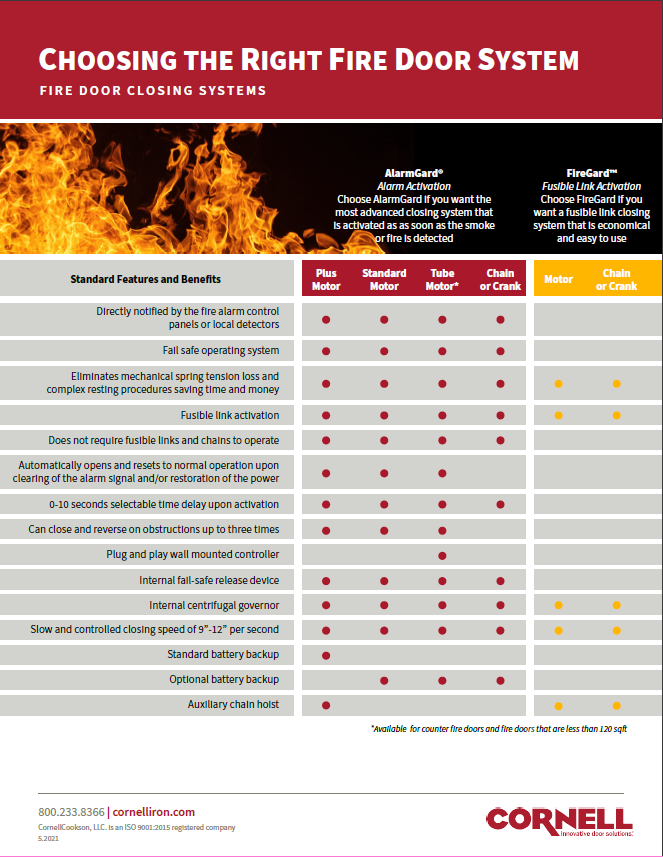
Fire Door System Operation: M100 FireGard Closing Systems are recommended. Available in electric motor, chain or crank, M100 Closing Systems offer the following benefits:
- Simplified, less costly testing and resetting of the automatic closing system from floor level, minimizing opening downtime.
- Eliminate mechanical spring resetting and complicated resetting and testing, especially on recessed and larger doors.
- Safe, controlled, automatic closing speed will not exceed 9" per second.
- Can be applied consistently on fire door, insulated fire door, counter fire door and SmokeShield® products.
- UL Certification allows Cornell to retrofit M100 operators to most manufacturer’s fire doors while maintaining the door’s UL and FM ratings.
Download the M100 FireGard™ Closing Systems data sheet for a full description of these systems, or use the Operator Information link under Fire Doors from the menu at right for more information. Or, view Cornell's M100 FireGard™ Video
Conventional fire door automatic closing systems release spring tension and require mechanical resetting by a trained door systems technician. Although these old fire door systems are available and frequently specified, the industry has evolved to address today’s issues of annual door testing requirements, more frequent alarm testing, recessed installation and power outages. Cornell strongly recommends you consider the safety and convenience advantages our M100 Closing Systems provide.
All Cornell fire products are provided with a multiple fuselink set-up to close the door automatically when any link melts. Standard fuselinks are designed to melt at 165° F and are to be located at the ceiling level above the fire door. For units with an automatic closing system or tied into an alarm system or local detectors, a fuselink set-up is still provided as a back up mechanical closing system.
Release Device Options Releasing devices are electro-mechanical devices that enable automatic closing fire doors to respond to alarm signals from detection devices such as smoke detectors, heat detectors and central alarm systems. This permits closing the door before high temperatures melt the fusible link. Fusible links should always be used as back up to the releasing device.
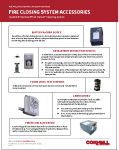
FIRE PRODUCT CLOSING SYSTEM ACCESSORIES
M100 Chain or Crank Optional Push to Close Station:
Option that simplifies operation and adds aesthetic appeal, replacing the floor level pull-to-close cable that is provided as standard. Designed for surface or flush mounting and includes a shielded cable that runs from the Close Station to the operator.
Fire Door Optional Release Devices
Release Devices are electro-mechanical devices that enable automatic closing fire doors to respond to alarm signals from detection devices, such as smoke detectors, heat sensors and central alarm signals, permitting doors to close long before high temperatures melt fusible links. Fusible links should always be used as backup to the release device. Note that electric M100 Motor Operated Systems do not require an additional mechanical release device to respond to alarm signals from detection devices.

M100 Chain or Crank Optional Release Devices:
for exclusive use with M100 Chain & Crank operators. They mount directly on-board the operators, require 120 volt AC input power and are fail-safe by design.
- Floor Level Cable Reset Model: includes a light gauge cable that runs to floor level. Following activation and door closing, resetting of the device is done at floor level by pulling on the cable.
- Automatic Reset Model: following activation and door closing, this release device automatically resets itself once the alarm is cleared and/or power is restored.
Conventional (Non-M100) Optional Release Devices
FIREGARD AR-D: A tri-voltage releasing device that does not contain
or require battery back-up support: power from the central alarm system is not required. It is a 100% fail-safe constantly energized solenoid mechanism designed for use on Cornell manual or motor operated rolling steel fire doors and counter fire doors with conventional drop out mechanisms. Complies with UL-864 - Control Units and accessories for fire alarm systems. AR-D Info Sheet.
FIREGARD DC: Designed to tie into and receive 24 volt DC power from a central alarm system that has a back-up power source. Activation of the central alarm system or local detector will cause an open fire door to close. Connection and voltage draw coordination with the alarm system provider is required. FireGard DC is UL listed with adjustable time delays for short power outages or alarm signals. When a remote "down" limit switch is added, this device also offers Down Limit Detection, which prevents mechanical release of a fully closed fire door. FireGard DC Owner's Manual
FireGard BB: Includes all the features of the FireGard DC unit, but contains its own 24 volt DC battery back-up power source that continues to power the release device and up to four local smoke detectors and two warning devices up to 72 hours during a power outage. Can utilize a 120 or 24 volt AC or 24 volt DC power source. FireGard BB Owner's Manual
Cornell FireGard DC and BB Release Devices are listed with the California Office of the State Fire Marshal.
Conventional Fire Door Annunciators:
Optional Sounder/Strobe or Voice Warning Modules can be tied into FireGard BB release devices to safely pre-announce closing of the fire door.
Sounder/Strobe: ADA compliant, 24 volt DC warning devices are powered by the release device battery source to provide advanced warning, even during a power failure.
Voice Warning Module: An optional FireGard BB warning device. The voice warning is in English, with other languages available. Is not ADA compliant.
Cornell Fire Product Closing System Accessories